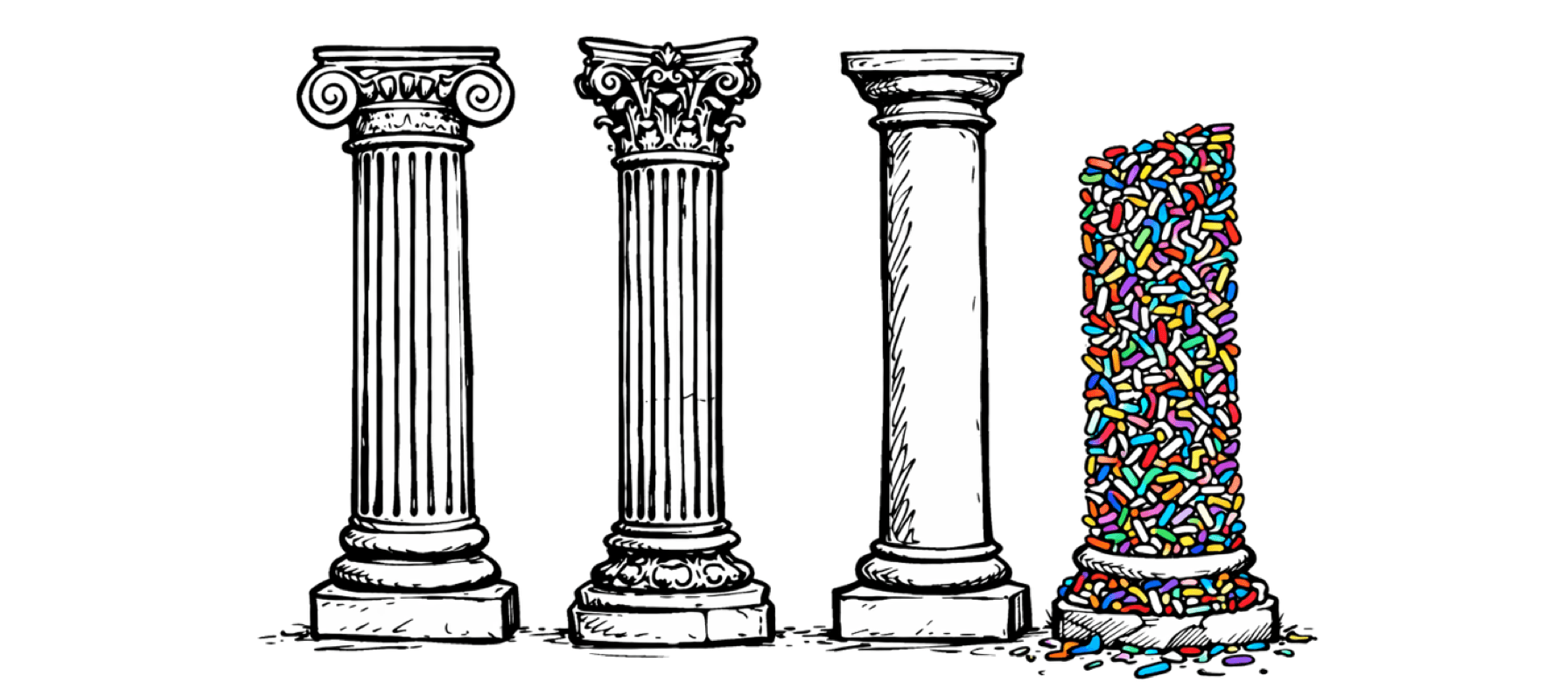

tl;dr - These are the things we value as a UX designers. If we’re doing all of these things, we’ll create incredible value, delight our users, and save our teams time and effort:
- Advocate for our users
- Simplify UX to compete in a crowded market
- Build towards a system
- Sprinkle in delight where others can’t
1. Advocate for our users
When our customers struggle, 1) we don’t always know how they’re struggling and 2) we don’t know always know why. They’re not going to call us for every small annoyance or inconvenience. They’re going to wait until a problem is so frustrating that complaining to Subsplash becomes the priority in their busy lives.
When we hear about a design gap or bug from our customers, that signals that many other customers are likely feeling the same problem but not telling us about it. A “small” issue could be sapping time away from every one of our thousands of customers. That’s why it’s crucial for us to be proactive about the needs of our customers, understand the problems they have, and solve them before they beg us to listen.
Once we empathize with our customers we can represent them, like an attorney. We can represent them in our decisions, and speak their voice into our process. We can be their advocate. It’s important to remember that they’re paying our salaries through their subscription, but they don’t have to keep paying for it. They can choose to take their business elsewhere. In order to sustain our salaries and continue providing a valuable service, we owe it to our customers to constantly add real value to their lives and simplify their workflows when they use our products.
We make time to listen to our customers and understand their problems, and empathize with what they need. Then we do everything we can to ensure simple and delightful solutions to their problems are built into our products.
2. Simplify UX to compete in a crowded market
There are so many website and app builders out there. There’s half a dozen ways to livestream your church service, and many are free. Why should a busy church leader choose Subsplash? Subsplash aims for higher standard—a better UX than our competitors, simple interactions across the board, and unique value from the way our products work together. Each Subsplash product a customer adopts should create more value than the sum of its features.
In addition to product cohesion, if a product has an outdated, clunky UX, there aren’t many reasons for a paying customer to stick around when they can find a better product for half the price in one Google search. Competition in the SaaS industry forces us to stay up-to-date and match patterns and best practices popularized by other products and services. People spend 99% of their time on some other app or website. Our products must speak the same modern, state-of-the-art design language of the products our customers use every day. And if they don’t, customers will be totally justified in leaving to go use another better product.
Our products are more than just the sum of their parts—they work together to add value in unique ways only found on our platform. Every product a customer adopts multiplies their total value gained. Our products speak the same modern design language of the various products our customers use every day.
3. Build towards a system
I’m going to use a goofy example to make a point, so please bear with me.
Imagine a group of 100 drones sitting on the ground in neat little rows on a football field. Each drone is turned on and humming, but they’re not moving yet. The whole Subsplash Product & Engineering team sits on the edge of the field with their own drone controller, ready to fly their own drone.
All of those drones are connected to a heavy log by individual ropes. The objective for our team is to use the drones to move the heavy log 100 yards down the field. A drone can’t move the log on its own—it won’t even budge. Since the log is so heavy, it will take at least 90 of these drones working together to move the log. How do we move the log?
If everyone starts flying with a general direction to “move the log down the field”, it will be chaos. Drones will collide and explode in flames, ropes will tangle, and maybe 10 drones will still be flying at the end, pathetically tugging at the log before they faceplant into the ground with a dismal “bzztffff”. By contrast, if we have a pre-determined flight plan and a set of carefully timed operating procedures, we can move the log, spin it around, and land the drones safely. And avoid the flames.
This contrived example is a fun way to think about our design system—as a flight plan. Without a flight plan, we’re all piloting our own drones. We’re all making dozens of decisions each day with different assumptions. We’ll build one-off implementations of components all over the place. Updating the platform becomes progressively harder and harder because everything is fragmented, and it never feels like we’re building any momentum. We won’t be able to make progress on massive team goals.
In contrast, when we have a flight plan, a design system, we know where we’re headed.
We know the types of components that should be used in every situation. It’s the equivalent of learning the rules of the road, so that we avoid collisions. And when there aren’t any collisions, the system speeds up and becomes more and more efficient.
4. Sprinkle in delight where others can’t
Building software is incredibly complicated. Beyond just software engineering (which can take a lifetime to master), the other roles on a cross-functional development team (UX, product management, agile methodology) all come with their own incredibly high skill ceilings. We’re all learning how to do this “software thing” together, and learning every sprint. But it’s hard to take off one hat and put on another. For many, seeing a problem through the eyes of a different role on your team can be draining.
This means that tiny moments to show humanity, create a smile, or put customers at ease are the first things that get passed over by engineers and product managers, because they’re well, quiet. They’re shy. They hide in the background and they’re hard to fully realize without someone to draw them out. Usually there’s just too many other things to do for team members to notice these critical moments in the customer journey, and it’s easier to keep your head down, move on, and stick to the plan. When these moments get overlooked, it leads to a product that doesn’t reach its full potential.
That’s where the UX team can shine. The UX team does have the time, focus, and energy to detect “aha” or “peak” moments and use them to sprinkle in delight. To squeeze all the juice out of them. UX regularly listens to our customers and understands their problems, so we’re some of the most well-equipped to identify these moments. When we identify these “aha” or “peak” moments, we should advocate hard to make them really great, despite implementation complexity or competing priorities. Extra time spent on nailing “Aha” or “peak” moments is worth at least 3x the effort, and can shift customers from disinterested users to superfans.
Using copy, illustration, and effortlessly simple workflows, UX Designers can turn an otherwise clunky or complicated experience into one that doesn’t even need UI, or one that’s so simple it’s frictionless. And customers that encounter these delightful peak moments tell new customers how much they love our products, creating new subscriptions. Everyone wins.
We anticipate moments to add delight throughout our products, and build products in a simple way that exceed customer expectations. We use simple language that is friendly, but not chummy, natural, but not too casual. Less is more.